Tag: Peter J. Dunn Award

Sustainable Manufacturing of BMS-986278 Leveraging an ERED/KRED Biocatalytic Cascade

2023 Peter J. Dunn Award for Green Chemistry & Engineering Impact in the Pharmaceutical Industry

Bristol-Myers Squibb was awarded for the “Sustainable Manufacturing of BMS-986278 Leveraging an ERED/KRED Biocatalytic Cascade.” The BMS team’s work demonstrated the use of an ERED/KRED biocatalytic cascade to enable the efficient installation of two stereocenters on a cyclohexyl ring as well as other improvements leading to a reduced number of isolations, elimination of the use of halogenated solvents, reduction of overall Process Mass Intensity (PMI) by 86% from first to second generation, and reduction of projected raw material costs by 82%. BMS team members included Michael Smith, Yichen Tan, Candice Joe, David George, Michael Dummeldinger, Harshkumar Patel, Richard Fox, Shane McKenna, and two Codexis colleagues,  Zara Seibel, and Stephan Jenne.
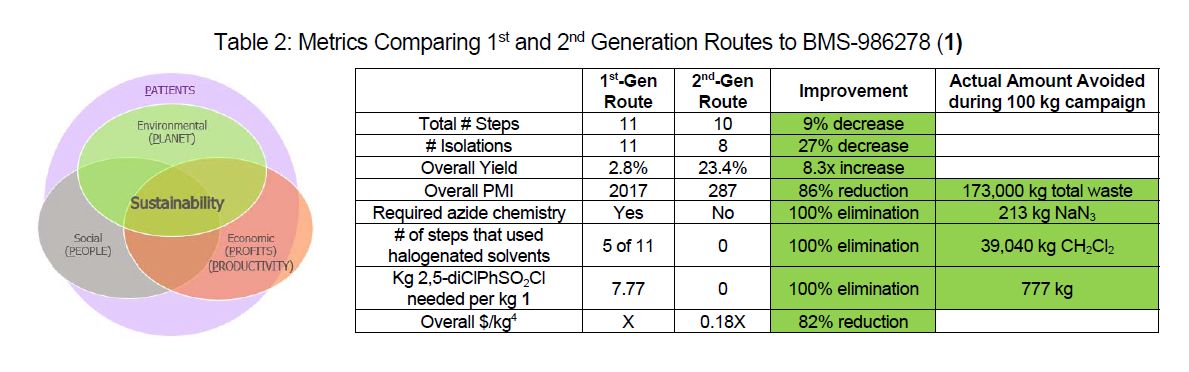
BMS sustainability metrics comparing the first and second generation routes.

More about the Award

The Peter J. Dunn Award, established in 2016, recognizes outstanding industrial implementation of novel green chemistry and/or engineering in the pharmaceutical industry that demonstrates compelling environmental, safety, cost, and/or efficiency improvements over current technologies.

This annual award is presented at the Green Chemistry & Engineering Conference where a member of the winning team is invited to share their team’s innovations. 

Pictured: Richard Fox, Scientific Director at BMS, accepts the 2023 Pete Dunn Award from ACS GCIPR 2023 Co-Chairs, Dan Bailey of Takeda (right) and Pippa Payne of Gilead (left). Also pictured is Zara Seibel, Senior Scientist at Codexis, part of the winning team.
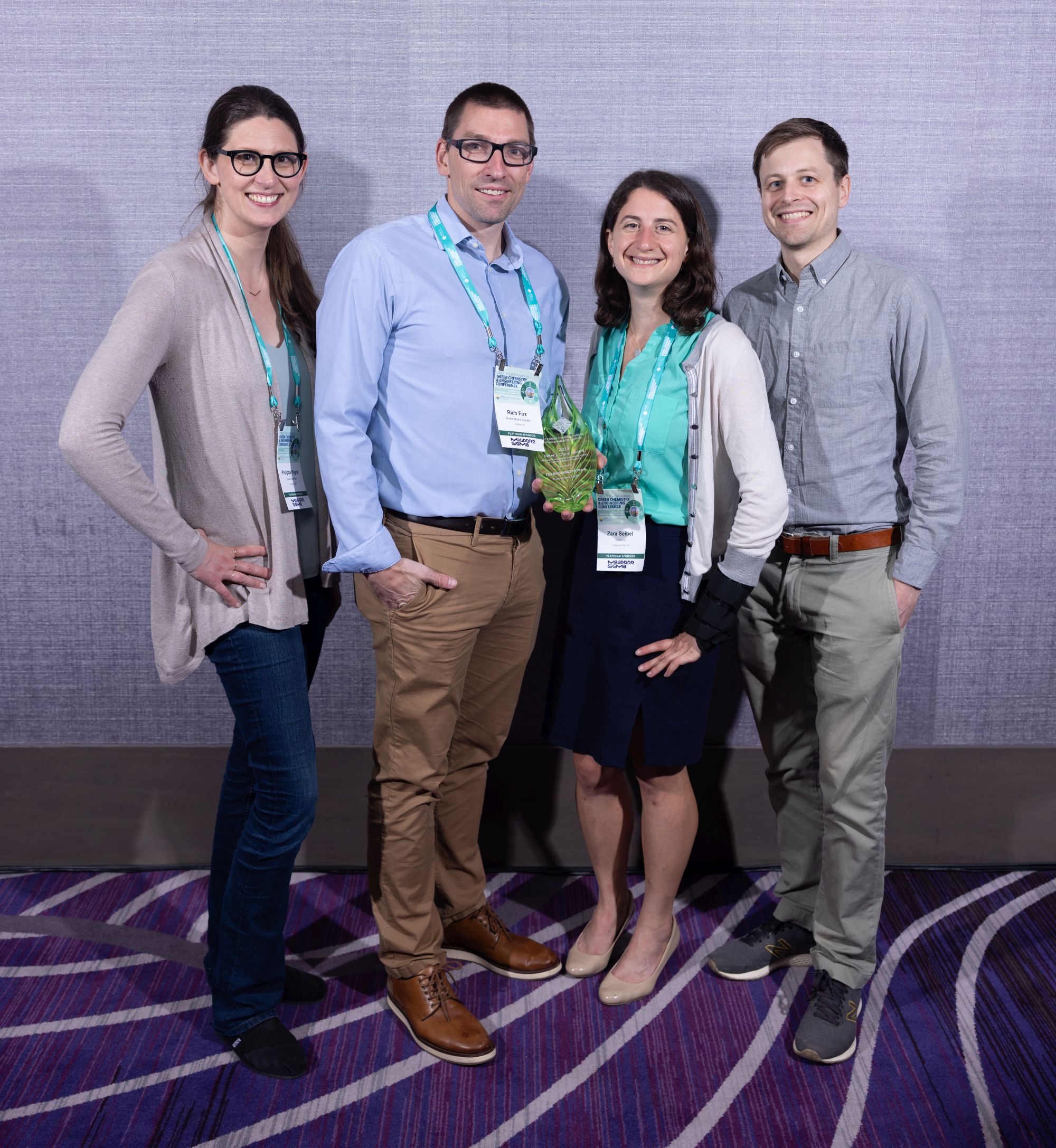
BMS receives 2023 Pete Dunn Award

Continue reading

From wood pulp to a candidate medicine: Green manufacturing technologies enable the production of investigational leukemia drug nemtabrutinib from a biorenewable commodity material

2022 Peter J. Dunn Award for Green Chemistry & Engineering Impact in the Pharmaceutical Industry

A team from Merck in Rahway, NJ is the recipient of the 2022 Peter J. Dunn Award for Green Chemistry and Engineering Impact in the Pharmaceutical Industry. Merck team members receiving the award are Karla Camacho Soto, Mike DiMaso, Jacob Forstater, Nadine Kuhl, Reed Larson, Chris Prier, and Ben Turnbull. 

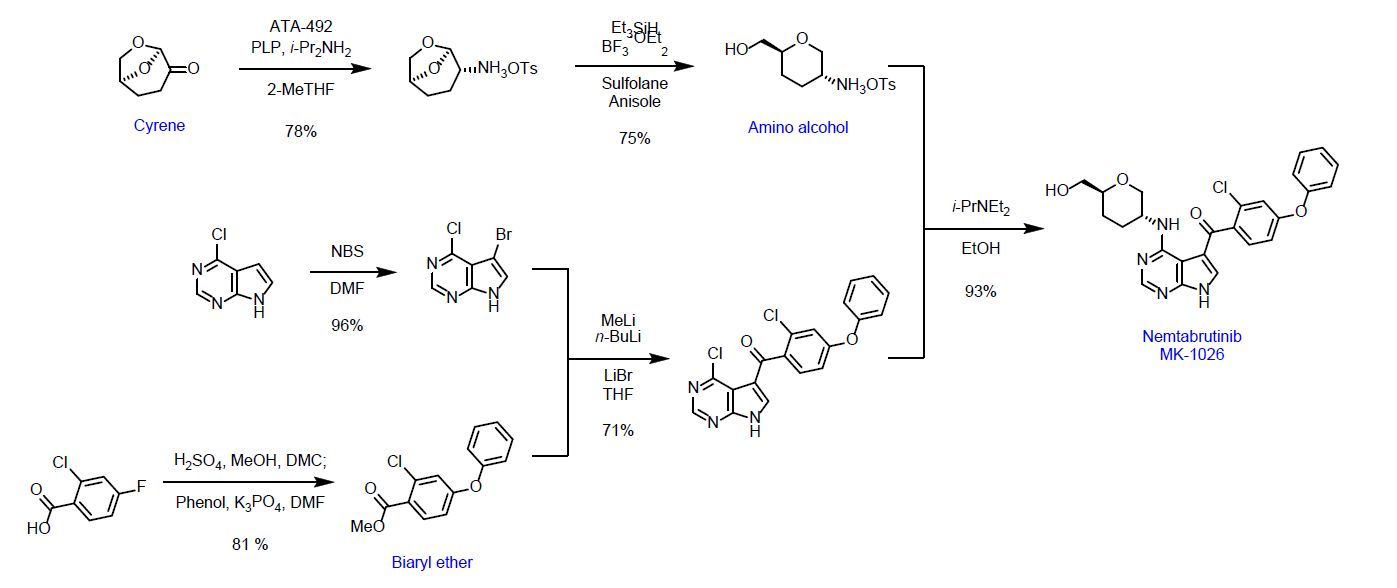
The initial manufacturing process for nemtabrutinib—acquired through the purchase of ArQule, Inc.—relied on an 11-step synthesis. The Merck team was able to reduce this to two steps. They were also able to replace toxic solvents with biorenewable Cyrene, avoid a highly energy-intensive transformation, and employ catalysis to improve efficiency. Three new technologies were employed to contribute to the sustainability of the process: biocatalysis, enzyme immobilization, and continuous manufacturing in a packed-bed reactor. Merck estimates that the new process reduces energy utilization 70%, as well as seeing a 70% reduction in both carbon dioxide and wastewater generation.

“The development and deployment of enabling technologies that support the most robust long-term supply of our medicines and vaccines is a primary goal of our process research and development team, and we are confident that biocatalysis will continue to grow as a key driver of efficient manufacturing processes,” says L.-C. Campeau, Associate Vice President and the Head of Small Molecule Process Research & Development at Merck.

MK-1026 chemical manufacturing process

Figure 1. New MK-1026 chemical manufacturing process.

More about the Award

The Peter J. Dunn Award, established in 2016, recognizes outstanding industrial implementation of novel green chemistry and/or engineering in the pharmaceutical industry that demonstrates compelling environmental, safety, cost, and/or efficiency improvements over current technologies.

This annual award is presented at the Green Chemistry & Engineering Conference, where representatives of the winning team are invited to share their team’s innovations. 

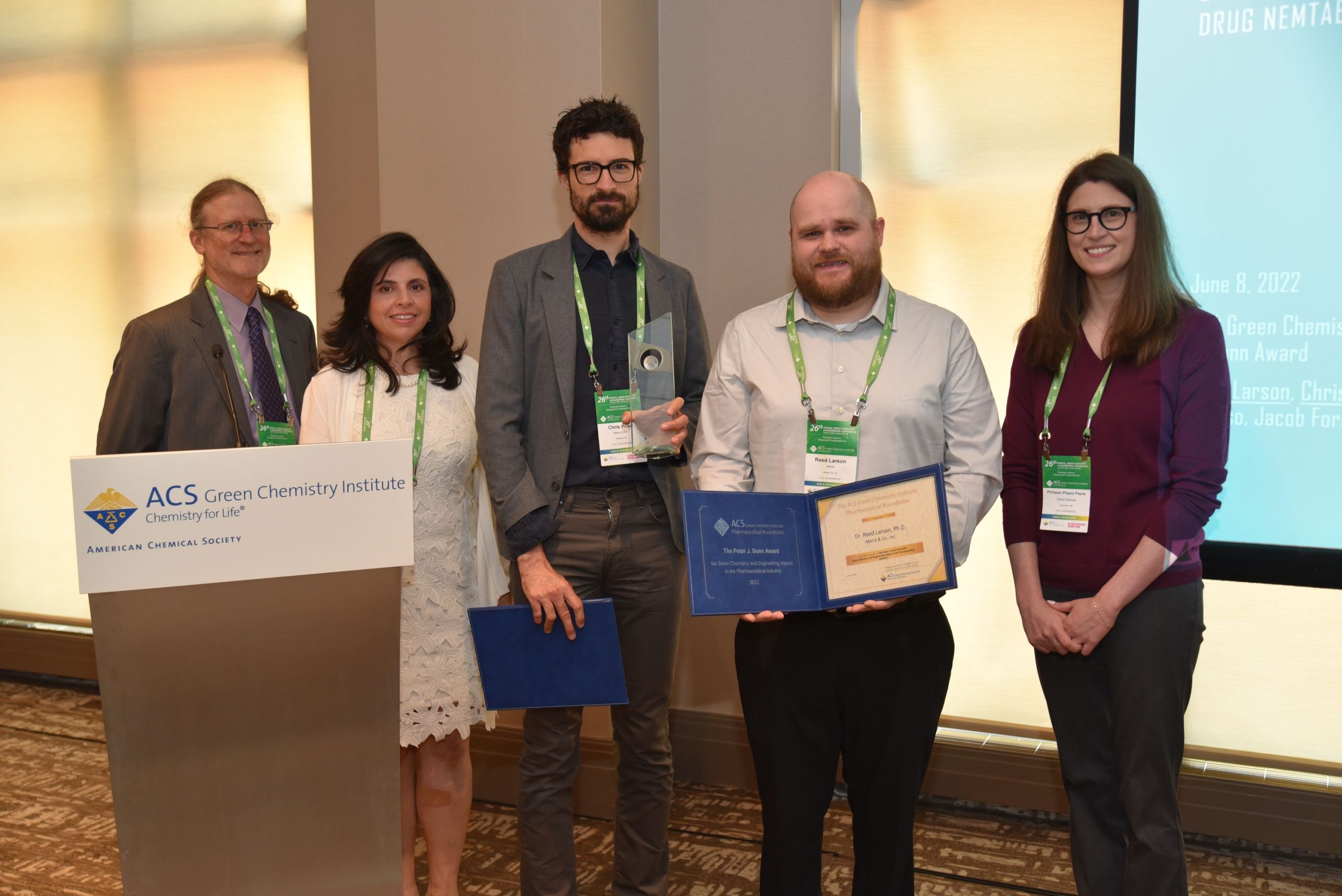
Pictured: Chris Prier and Reed Larson, Associate Principal Scientists at Merck, accept the 2022 Pete Dunn Award from David Constable and Isamir Martinez (ACSGCI) and ACS GCIPR 2022 Co-Chair, Pippa Payne of Gilead.

Merck receives 2022 Peter Dunn Award

Continue reading

Greener Manufacturing of Belzutifan Featuring a Photo-Flow Bromination

2021 Peter J. Dunn Award for Green Chemistry & Engineering Impact in the Pharmaceutical Industry

A team from Merck, Stephen Dalby, François Lévesque, Cecilia Bottecchia and Jonathan McMullen, recieved the 2021 Peter J. Dunn Award for their innovation, “Greener Manufacturing of Belzutifan (MK-6482) Featuring a Photo-Flow Bromination.”

Belzutifan is an important new drug used in the treatment of cancer and other non-oncology diseases. Acquired by Merck in 2019 through the purchase of Peloton Therapeutics, a new, greener manufacturing process for its synthesis was needed. Over the next 18 months, the team developed a more direct route from commodity chemical to API, employed new reaction conditions, particularly in the oxidation sequence, and incorporated new technology, photo-flow.

Despite this accelerated timeline, the team achieved a five-fold improvement in overall yield with a commensurate 73% reduction in process mass intensity (PMI) compared to the original route. Notably, the Merck team also developed a visible light-initiated radical bromination performed in flow. According to the L.-C. Campeau, Executive Director and Head of Process Chemistry and Discovery Process Chemistry at Merck, this is the “first example of a photo-flow reaction run on manufacturing scale at Merck and represents the linchpin of the synthesis.”

The improved process for Belzutifan, which is expected to launch this year, will reduce the waste associated with its manufacture and is aligned with Merck’s corporate sustainability goals.

“The Merck team delivered an excellent example of the application of innovative technologies to develop a more sustainable synthesis of the pharmaceutically-active compound, Belzutifan,” comments Paul Richardson, Director of Oncology and Chemical Synthesis at Pfizer and Co-Chair of the ACS GCI Pharmaceutical Roundtable. “Using the guiding principles of green chemistry, for example, in the use of catalysis and a relatively benign reaction media, further illustrate the Merck team’s work as worthy of recognition for the 2021 Peter Dunn Award.”

More about the Award

The Peter J. Dunn Award, established in 2016, recognizes outstanding industrial implementation of novel green chemistry and/or engineering in the pharmaceutical industry that demonstrates compelling environmental, safety, cost, and/or efficiency improvements over current technologies.

This annual award is presented at the Green Chemistry & Engineering Confernece where presenters are invited to share their innovations. 

Continue reading

Beyond Organic Solvents: Synthesis of a 5-HT4 Receptor Agonist in Water

2020 Peter J. Dunn Award for Green Chemistry & Engineering Impact in the Pharmaceutical Industry

The recipient of the 2020 Peter J. Dunn Award is Dan Bailey of Takeda Pharmaceuticals. Bailey is based at Takeda’s R&D facility in Cambridge, Mass.

Bailey’s technology, titled “Beyond Organic Solvents: Synthesis of a 5-HT Receptor Agonist in Water,” uses Takeda’s pre-existing TAK-954 process as a test case to demonstrate the feasibility of implementing reactions in water. The technology simultaneously comprises all three focus areas of the award: 1) greener, more sustainable synthetic routes and their associated processes to Active Pharmaceutical Ingredients (API) or intermediates, 2) reaction conditions, and 3) chemical or manufacturing process technologies as applied at meaningful scale. Bailey’s technology achieves this by developing greener reaction conditions while reducing a six-step synthesis (all reactions and isolations from water) to four.

Bailey developed a potential alternative to Takeda’s TAK-954 six-step current manufacturing sequence to be run almost entirely in water. Doing this replaces five separate organic solvents and simultaneously implements five direct isolations from aqueous media. Key transformations carried out in aqueous media include a benzimidazole cyclization, amidation, reductive amination, and a selective oxidation of an aliphatic alcohol. Because the reductive amination and aliphatic alcohol oxidation using the new surfactant technology were not previously described in the literature, new methodologies were invented specifically for this application. In addition to shortening the synthetic route by two steps and removing the vast majority of organic solvents from the process, Bailey and his team were able to reduce the overall PMI (Process Mass Intensity) from 350 to 111. The team noticed that shifting the reaction and isolation media from organic solvents to water had additional benefits. These include reducing the portion of the PMI attributable to solvents from 223 to 19 and, surprisingly, reducing the portion of the PMI attributable to water from 106 to 76.

More about the Award

The Peter J. Dunn Award, established in 2016, recognizes outstanding industrial implementation of novel green chemistry and/or engineering in the pharmaceutical industry that demonstrates compelling environmental, safety, cost, and/or efficiency improvements over current technologies.

This annual award is presented at the Green Chemistry & Engineering Confernece where presenters are invited to share their innovations. 

Continue reading