Author: Christiana Briddell

Sustainable Manufacturing Process for Commercial and Developmental Stage Intermediates through Two Consecutive Flow Reactions using Micro-packed Bed Technology

2024 CMO Excellence in Green Chemistry Award

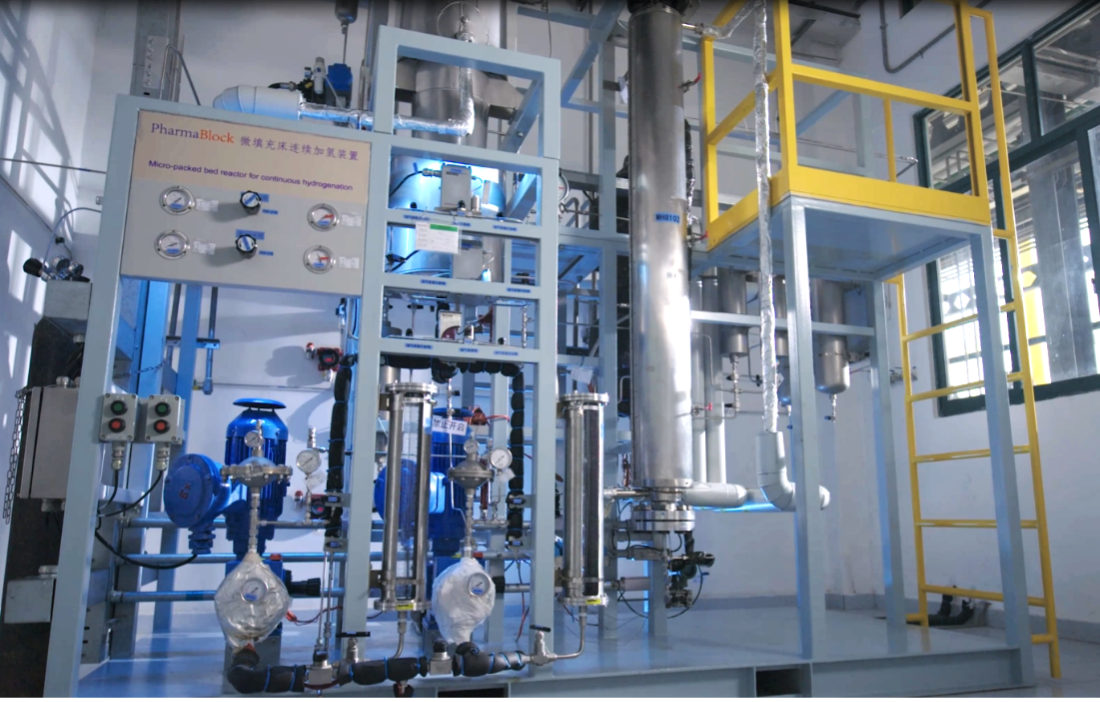
The PharmaBlock team was selected based on their innovative work on “Sustainable Manufacturing Process for Commercial and Developmental Stage Intermediates through Two Consecutive Flow Reactions using Micro-Packed Bed Technology.” Team members are Feng Zhang, Guangchao Ma, Dafen Wen, Yang Zhu, and Yuanxian Wang, all based in Nanjing, China. Their project demonstrated the use of micro-packed bed technology to produce tert-Butyl 3-oxoazetidine-1-carboxylate and tert-Butyl 3-aminoazetidine-1-carboxylate through oxidation reactions and reductive amination reactions at scale, resulting in improvements to safety, equipment volume efficiency, process mass intensity (PMI), greenness, and cost efficiency.

Pharmablock reactor equipment.

More about the Award

The CMO Excellence in Green Chemistry Award seeks to recognize outstanding efforts by CMO companies in pharmaceutical green chemistry in support of pharmaceutical research, development, and manufacturing that demonstrate compelling environmental, safety, and/or efficiency improvements. The award recognizes greener advances in synthetic route development for starting materials, intermediates, or active pharmaceutical ingredients (APIs), including reaction conditions and chemical or manufacturing technologies.

This annual award is presented at the Green Chemistry & Engineering Conference where a member of the winning team is invited to share their team’s innovations. 

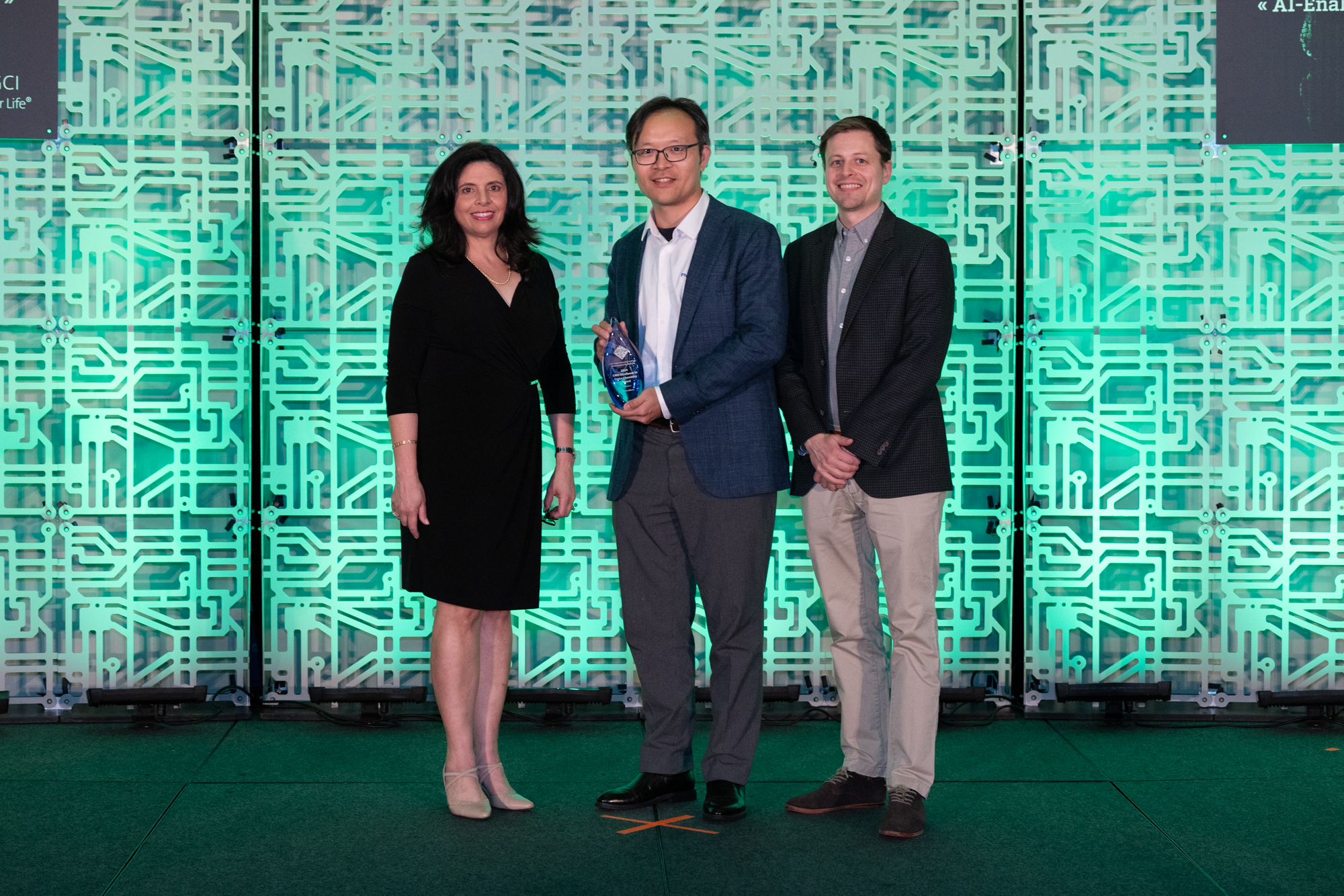
Pictured: Wang Yuanxian, Director of R&D at PharmaBlock, accepts the 2024 CMO Excellence in Green Chemistry Award from Isamir Martinez (ACSGCI) and ACS GCIPR 2024 Co-Chair, Dan Bailey of Takeda.

PharmaBlock accepts award.

Continue reading

PMI Prediction and Bayesian Optimization: Two Tools with One Goal Towards the Development of ‘Greener-by-Design’ Synthesis of APIs

2024 Data Science & Modeling for Green Chemistry Award

The Bristol Myers Squibb team received the innaugral Data Sciences and Modeling Award for Green Chemistry award. 

Richard Fox, Jun Li, Jacob Albrecht, Jason Stevens, Jose Tabora, Alina Borovika, and Benjamin Shields (BMS) partnered with Jose Garido (Princeton), Professor Ryan Adams (Princeton), and Professor Abigail Doyle (UCLA) to showcase two tools that are combined to arrive at greener processes during the design, development, and optimization of synthetic transformations. A process mass intensity (PMI) prediction app that utilizes predictive analytics and historical data of large-scale syntheses to help enable better decision-making during ideation and route design was coupled with a subsequent Experimental Design via Bayesian optimization application (i.e., EDBO/EDBO+) to accelerate the optimization of the subsequent individual chemical transformations was included. Taken together, these two tools enable process scientists to incorporate state-of-the-art open-access data science tools and algorithms into both defining their overall project strategies and conducting their daily laboratory experimentation to accelerate the advancement of “greener-by-design” outcomes.

Highlighting a real clinical candidate, the authors illustrated a quantitative method for the prediction of potential efficiencies centered around Process Mass Intensity (PMI) of proposed synthetic routes prior to their evaluation in a laboratory. This allows scientists to select the most efficient option prior to development and arrive at a holistically more sustainable chemical synthesis to a molecule moving into manufacturing. Following predictions for PMI across different synthetic sequences, the researchers rapidly identify the optimized conditions for a particular transformation using a machine learning Bayesian optimization (BO)n approach to explore chemical space and identify more sustainable reaction conditions with fewer experiments and resources. For the specific example included in their work, a process that yielded 70% yield and 91%ee through traditional one factor at a time (OFAT) using 500 experiments, was surpassed by the EDBO+ platform, providing 80% yield and 91%ee in only 24 experiments. Both technology platforms are open source and available for researchers at no charge, increasing the potential for adoption and use by others.

More about the Award

The Data Science and Modeling for Green Chemistry award recognizes innovation or excellence in the research and development of computational tools that empower users to effectively design, implement, and evaluate green processes with reduced process mass intensity, waste, health and safety impact, and other aspirational improvements. The award was open to both academic and industrial applicants, and a number of excellent nominations were received for consideration. 

This annual award is presented at the Green Chemistry & Engineering Confernece where presenters are invited to share their innovations. 

Pictured: Jason Stevens, Associate Scientific Director at BMS, accepts 2024 Pete Dunn Award from Isamir Martinez (ACSGCI) and ACS GCIPR 2024 Co-Chair, Dan Bailey of Takeda.

BMS accepts Data Science & Modeling for Green Chemistry award

Continue reading

Development of a short and eco-friendly asymmetric manufacturing process for Spiroketone CD 7659

2024 Peter J. Dunn Award for Green Chemistry & Engineering Impact in the Pharmaceutical Industry

The Boehringer Ingelheim team—Yongda Zhang, Eugene Chong, Jada White, Suttipol Radomkit, Yibo Xu, Jon Lorenz, and Linglin Wu—was selected for their innovative work developing a short and eco-friendly manufacturing process for Spiroketone CD 7659—a common intermediate used in multiple projects within the company. The team’s new 3-step asymmetric synthesis route improved the yield nearly five-fold from 10 to 47 percent, reduced organic solvent usage by 99 percent, eliminated use of halogenated solvent, and reduced water usage by 76 percent. The sustainability achievements were further highlighted by a PMI of 117, 72 percent Relative Process Greenness (RPG) score, and an “excellent” innovation Green Aspiration Level (iGAL), placing it in the top 10 percent of industry processes. The team highlighted that their process can be scaled to meet and exceed a projected demand of more than 13 tons of the product which will result in saving more than 69,327,473 kg of waste compared to the initial process for one project.

Figure: This iGAL 2.0 scorecard shows the sustainability improvements of Boehringer Ingelheim’s new process for manufacturing Spiroketone CD 7659 over the incumbent process.

Image shows an iGAL 2.0 scorecard.

More about the Award

The Peter J. Dunn Award, established in 2016, recognizes outstanding industrial implementation of novel green chemistry and/or engineering in the pharmaceutical industry that demonstrates compelling environmental, safety, cost, and/or efficiency improvements over current technologies.

This annual award is presented at the Green Chemistry & Engineering Confernece where presenters are invited to share their innovations. 

Pictured: Yongda Zhang, Distinguished Research Fellow at Boehringer Ingelheim, accepts 2024 Pete Dunn Award from Isamir Martinez (ACSGCI) and ACS GCIPR 2024 Co-Chair, Dan Bailey of Takeda.

Yongda Zhang receives Peter J. Dunn Award on behalf of Boehringer Ingelheim.

Continue reading

Sustainable Manufacturing: Green Chemistry Breakthroughs in Pharma

Celebrate groundbreaking advancements in green chemistry and engineering in the pharmaceutical industry, featuring the 2024 Peter J. Dunn Award winners. Established in 2016, the Award recognizes exceptional industrial implementations that achieve significant environmental, safety, cost, and efficiency improvements over existing technologies. This year’s honorees, Boehringer Ingelheim and GSK, have set new standards in sustainable manufacturing.

Boehringer Ingelheim’s team created a highly efficient 3-step synthesis for Spiroketone CD 7659, used across multiple projects. Join Yongda Zhang, a Distinguished Research Fellow in Process Research at Boehringer Ingelheim as he discusses how their process improved yield nearly five-fold, reduced solvent usage by 99 percent, and eliminated halogenated solvents. The sustainability impact was significant, with a PMI of 117, an outstanding Relative Process Greenness (RPG) score of 72 percent, and a top-tier innovation Green Aspiration Level (iGAL). Scalable to meet increasing demand, learn how their method will save over 69 million kg of waste at one of the world’s largest pharmaceutical companies. GSK’s team developed a second-generation route for manufacturing the cancer drug maleimidocaproyl monomethyl auristatin F (mcMMAF) which reduces solvent consumption by 16,160 kg per kilogram of product, cuts greenhouse gas emissions by 71 percent, and slashes energy consumption by 76 percent. Join Danny Mancheno, a Research Scientist at GSK as he discusses their innovative approach that also eliminated single-use silica gel chromatographic separations, achieving an impressive 76 percent reduction in Process Mass Intensity (PMI). 

Don’t miss this opportunity to learn from industry leaders in the sustainability space as they share insights into these award-winning projects and their contributions to a greener future. This ACS Webinar is moderated by John Tucker of Neurocrine Biosciences and is co-produced by the ACS Green Chemistry Institute Pharmaceutical Roundtable.

Watch the Webinar

Picture of a scientist in a lab

Continue reading

A Chemistry in Water Reproducibility Study: Learnings from a Pre-Competitive, Multi-Company Collaboration

A Chemistry in Water Reproducibility Study: Learnings from a Pre-Competitive, Multi-Company Collaboration Richard Fox, Daniel Bailey, Jennifer Obligacion, Niginia Borlinghaus, Wilfried Braje, Xiaoyong Li, Subha Mukherjee, Adeline Schoen, Timothy Towne, Stella Vukelic., ChemRxiv. 2023. Publication Date: November 17, 2023. https://doi.org/10.26434/chemrxiv-2023-mgww0

Green Chemistry Articles of Interest to the Pharmaceutical Industry – September 2024

Green Chemistry Articles of Interest to the Pharmaceutical Industry. Melissa A. Ashley, Miles H. Aukland, Marian C. Bryan, Megan A. Cismesia, Theresa Dutschei, Oliver D. Engl, Pascal S. Engl, Álvaro Enriquez Garcia, Vanessa Harawa, George Karageorgis, Christopher B. Kelly, Alexandre Leclair, Johnny W. Lee, Zhen Lei, Wei Li, Jan Pawlas, Paul F. Richardson, Samuel C. Scott, Alan Steven, Balaram S. Takale, Dauzhan Yerkozhanov, and Mingshuo Zeng. Org. Process Res. Dev. 2024, 28, 9, 3450–3459. https://doi.org/10.1021/acs.oprd.4c00300